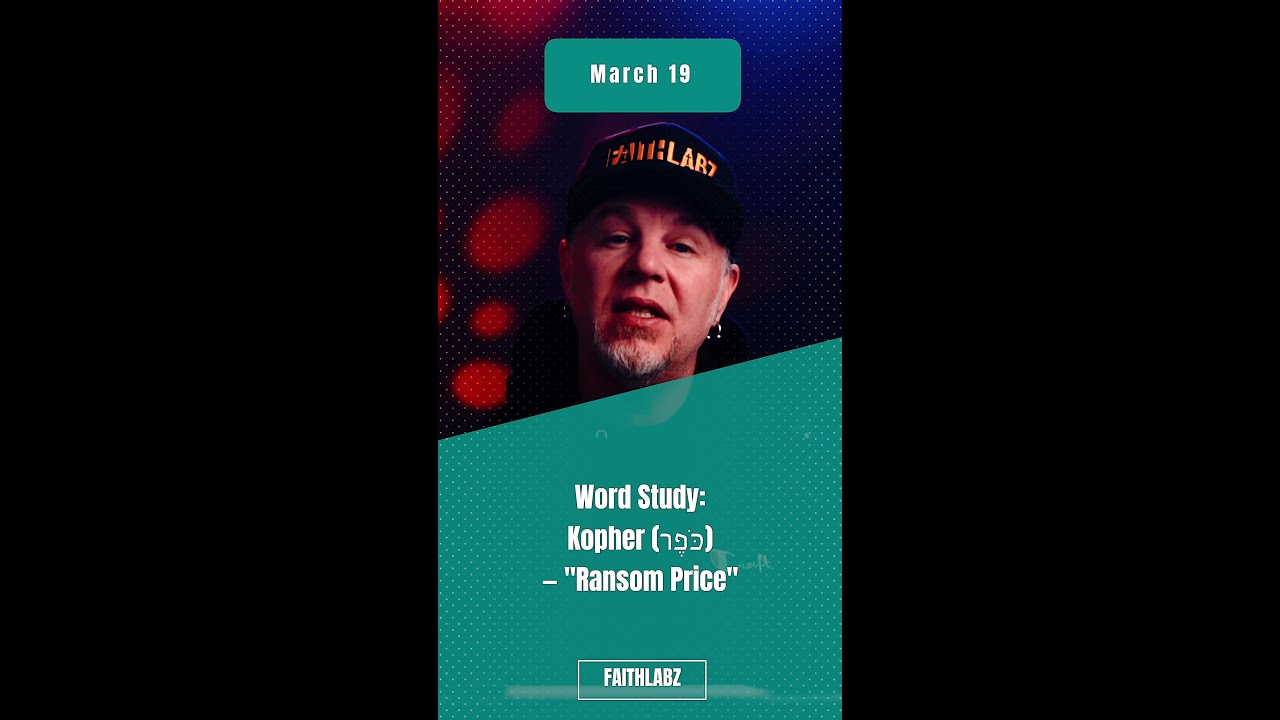
כֹּפֶר
Hebrew word · FaithLabz word study
כֹּפֶר
kopher
ransom price
Often translated: ransomransom priceredemptionbribesatisfaction
What kopher means
Kopher names a price paid to cover over a life that was forfeit. The literal core is a substitutionary payment, a sum that stands in place of a person who would otherwise die. In Exodus 21:30, when an ox gores someone to death, the owner faces execution unless he pays a kopher, a ransom price accepted in place of his own life. The word carries the physical weight of an exchange: one thing given so another thing is spared.
Kopher shares its root with the verb kaphar, which runs through the entire sacrificial system. To cover, to wipe away, to make atonement. The kopher is what makes the kaphar possible. It is the object of exchange that accomplishes the covering.
Numbers 35:31 draws the line hard: no kopher may be accepted for a murderer. Some lives are so serious that no payment can substitute. The very prohibition reveals what kopher normally does. It normally lets a substitute stand where a guilty person should stand.
The Psalms press the word into poetry. Psalm 49:7 declares that no person can give a kopher for another soul. No ransom price is sufficient. The cost of a human life exceeds every treasury. That verse sets up the whole biblical movement toward One whose kopher would be different in kind, not merely in quantity. The word lives between the courtroom and the altar, between debt and payment, between a life deserved and a life restored.
Why this word matters
Most of us read the word ransom and think of a kidnapping drama, a suitcase of money, a transaction. I spent years hearing ransom in the New Testament and feeling it as a metaphor, something poetic Jesus said about his death. Then I found kopher sitting underneath it in the Old Testament, and the poetry became a ledger. A real price. A real life counted as forfeit. A real exchange made so another person walks away. When Mark 10:45 says Jesus gave his life as a ransom for many, the Greek word lutron is doing what kopher taught the whole Old Testament to expect. Not poetry. Payment. Your name was on the account, and something was given in your place.
Etymology
Kopher derives from the root kaphar, a verb meaning to cover, smear, or make atonement. The same root produces kippur, as in Yom Kippur, the Day of Atonement. It also yields kofer, meaning pitch or tar, the substance Noah smeared over the ark to seal it against the flood. All these words share the idea of something applied that covers and protects. The semantic family moves from physical sealing to relational reconciliation.
Key Verses
Where kopher appears in Scripture, and why each verse showcases it.
Exodus 21:30ESV
If a ransom is imposed on him, then he shall give for the redemption of his life whatever is imposed on him.
This is kopher in its most concrete legal setting, a substitute payment accepted in place of an execution. It gives the word its courtroom weight before the altar ever comes into view.
Numbers 35:31ESV
Moreover, you shall accept no ransom for the life of a murderer, who is guilty of death, but he shall be put to death.
The prohibition on kopher for murder reveals by contrast how the word normally functions. The severity of the restriction proves that substitutionary payment was a real, accepted mechanism everywhere else.
Psalm 49:7ESV
Truly no man can ransom another, or give to God the price of his life.
The psalmist uses kopher to expose the limits of human payment. No price a person can offer equals a human soul, which makes the gospel's answer to this verse all the more staggering.
Proverbs 13:8ESV
The ransom of a man's life is his wealth, but a poor man hears no threat.
Kopher here enters the texture of everyday social life, showing that ransom was a category ancient Israelites understood as practical and immediate, not merely ceremonial.
Job 33:24ESV
And he is merciful to him, and says, 'Deliver him from going down into the pit; I have found a ransom.'
Elihu uses kopher in a passage about rescue from death itself. God finds the ransom price. The passive construction points forward to the One who would supply what no human treasury could.
Related Words
Words in the same semantic family.
1 Teaching on kopher
Every video where Adam teaches on this word, in publication order.