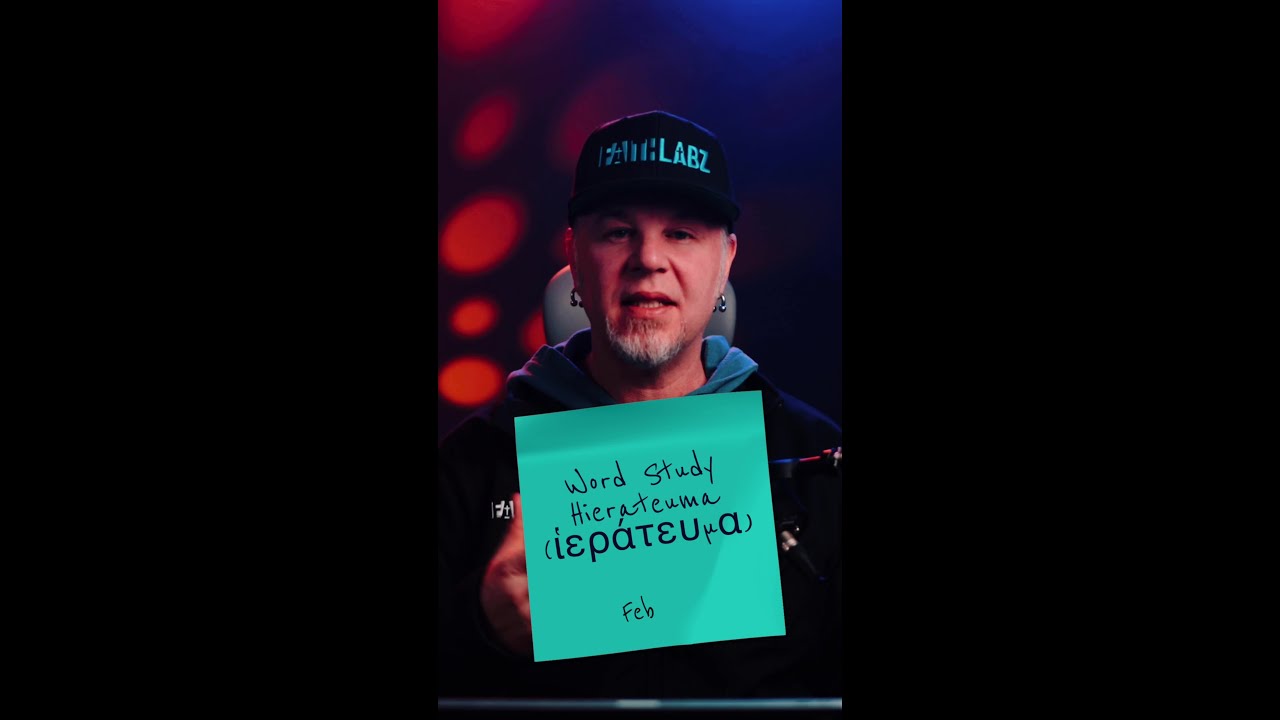
ἱεράτευμα
Greek word · FaithLabz word study
ἱεράτευμα
hierateuma
priesthood, priestly order
Often translated: priesthoodroyal priesthoodpriestly orderbody of priestspriestly community
What hierateuma means
ἱεράτευμα (hierateuma) names not merely the office of a priest but the entire body, the collective whole, constituted as a priestly community. The root sits in the noun ἱερεύς, meaning priest, and the suffix -teuma transforms it into something like 'priestly body' or 'priestly corporation.' It carries the sense of an organized, functioning group defined by its priestly calling, not a building, not a title, not a credential held by one person.
In the ancient world, access to the holy was guarded and mediated. You needed someone between you and the divine. The priest was that someone. He handled sacred things, offered sacrifices, represented the people before God and God before the people. The role was exclusive, inherited, and set apart.
When Peter reaches for ἱεράτευμα in 1 Peter 2:9, he is not softening anything. He is exploding the category. The whole assembly of Christ-followers now bears the title that once belonged to Aaron's line alone. Every baptized believer is part of this priestly body, constituted to offer spiritual sacrifices, to approach God directly, to intercede for the world around them. The word functions as both identity and vocation. You are not just called priestly; you are woven into a priestly body that exists to do something, to draw near, to offer, to declare. Peter likely borrowed the phrase directly from Exodus 19:6 in the Greek Septuagint, which means Christ-followers are being identified as the new covenant Israel, the people God is forming at a new Sinai.
Why this word matters
Most of us grew up either in a tradition that reserved something priestly for ordained clergy, or in a tradition that reacted so hard against that idea we stripped the word priesthood of any meaning at all. I spent years reading 'royal priesthood' in 1 Peter 2:9 as a feel-good phrase, a kind of spiritual participation trophy. I missed that Peter is installing his readers into a vocation. ἱεράτευμα is not decorative. It names what you are so you know what to do. You are part of a priestly body. That means you draw near to God. That means you intercede for your neighbors. That means your ordinary life, your suffering, your praise, your work, is the sacrifice you carry to the altar. You were not saved to sit. You were constituted into a body that mediates the presence of God to a world that cannot find its way in.
Etymology
From ἱερεύς (hiereus, 'priest') plus the collective suffix -teuma, which groups individuals into a functioning body. Compare with βασίλειον (royal) in the same verse. The root ἱερός means 'sacred' or 'holy,' and its family includes ἱερόν (temple), ἱερουργέω (to perform priestly service), and ἱερωσύνη (priesthood as an institution). The -teuma construction implies active, constituted function rather than mere status.
Key Verses
Where hierateuma appears in Scripture, and why each verse showcases it.
1 Peter 2:9ESV
But you are a chosen race, a royal priesthood, a holy nation, a people for his own possession, that you may proclaim the excellencies of him who called you out of darkness into his marvelous light.
This is the only New Testament use of ἱεράτευμα, and Peter piles it alongside three other identity-markers drawn from Exodus and Isaiah, making clear the church is the covenant people now constituted for priestly mission.
Exodus 19:6ESV
and you shall be to me a kingdom of priests and a holy nation. These are the words that you shall speak to the people of Israel.
The Septuagint renders 'kingdom of priests' with βασίλειον ἱεράτευμα, the exact phrase Peter echoes, anchoring the church's identity in God's original purpose for his covenant people.
1 Peter 2:5ESV
you yourselves like living stones are being built up as a spiritual house, to be a holy priesthood, to offer spiritual sacrifices acceptable to God through Jesus Christ.
Just four verses before verse 9, Peter uses the related term ἱεράτευμα's near-synonym ἱεράτευμα's verbal cousin to connect the priestly body to the act of offering, showing that the identity always points toward function.
Revelation 1:6ESV
and made us a kingdom, priests to his God and Father, to him be glory and dominion forever and ever. Amen.
John's doxology at the opening of Revelation echoes the same Exodus 19 tradition, confirming that the priestly identity of the whole church is not peripheral but central to what Christ has accomplished.
Revelation 5:10ESV
and you have made them a kingdom and priests to our God, and they shall reign on the earth.
The new song of the elders ties the priestly calling directly to future reign, revealing that ἱεράτευμα carries eschatological weight: the priestly body is moving toward a destiny, not just occupying a status.
Related Words
Words in the same semantic family.
hiereushierosynehierourgeōhierateiabasileion
1 Teaching on hierateuma
Every video where Adam teaches on this word, in publication order.