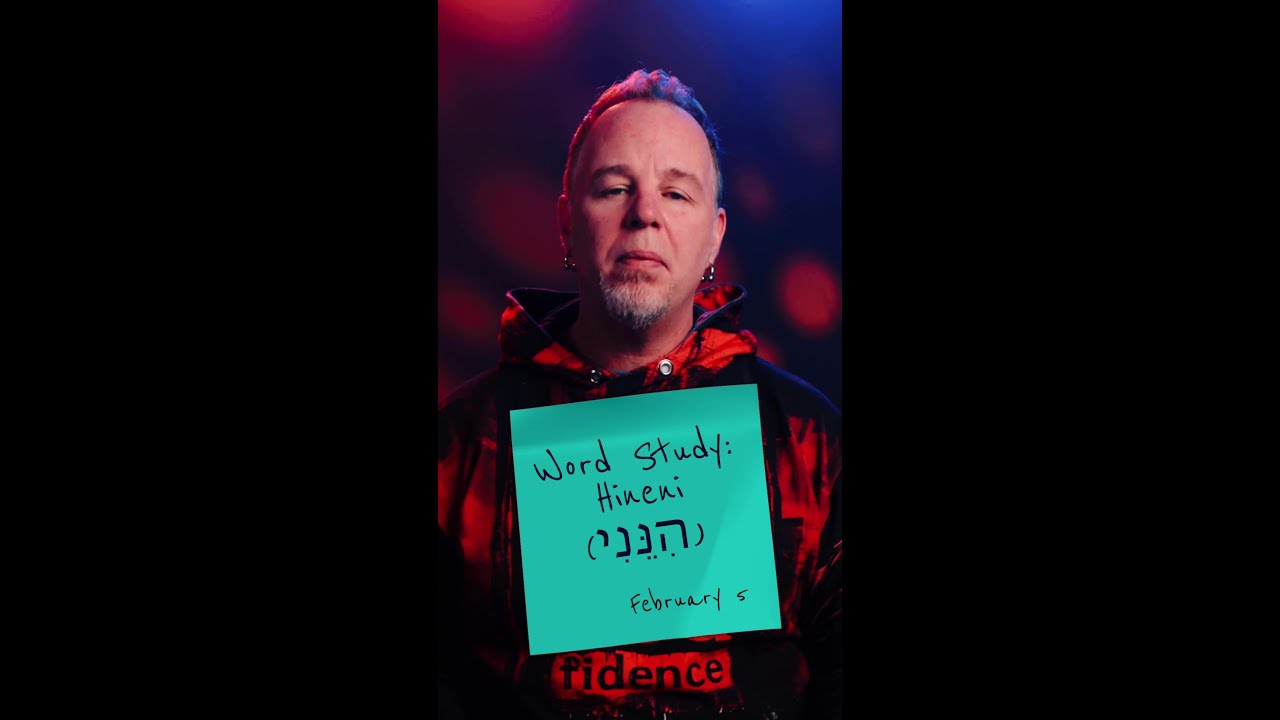
הִנֵּנִי
Hebrew word · FaithLabz word study
הִנֵּנִי
hineni
here I am
Often translated: Here I amBehold mePresentI am hereHere am I
What hineni means
Hineni is not simply a statement of location. It is a declaration of total availability. The word collapses the distance between a person and the one calling them. Literally, it combines the presentative particle hinneh, meaning 'behold' or 'look,' with the first-person singular suffix, giving you something closer to 'behold me' or 'here, I myself am.' English flattens this into 'here I am,' but that phrase sounds like roll call. Hineni sounds like a soldier stepping forward from the ranks.
The word carries a posture, not just a position. When Abraham says hineni to God at the start of the Akedah in Genesis 22, he is not reporting his GPS coordinates. He is presenting his whole self, undivided, to whatever comes next. He does not know yet what will be asked. That is the weight of the word. It is spoken before the demand is known.
The same word appears when Samuel hears his name in the night and responds to Eli, and then to God. It appears when Isaiah, undone in the throne room, volunteers for a mission he hasn't heard yet. In every case, hineni precedes the task. The speaker does not say 'tell me what you need and I will consider it.' The speaker says 'I am yours before you ask.' That pre-emptive surrender is the emotional core of this single word. It is the vocabulary of covenant faithfulness, spoken by people who trusted that the one calling them was worth answering.
Why this word matters
Most of us read 'here I am' and hear nothing more than an attendance answer. I did for years. I thought the drama of Genesis 22 lived in what God asked Abraham to do, not in Abraham's first two words. But hineni comes before the hard thing. Abraham doesn't know about Isaac yet when he says it. He steps forward into an unanswered question, offering himself to a God whose next sentence he cannot predict. That is a completely different spiritual posture than agreeing to something after you've read the fine print. Hineni is the word of a person who has already decided that the one calling them is trustworthy. It is covenant language dressed in three syllables, and it costs everything to mean it.
Etymology
Hineni derives from the Hebrew presentative particle hinneh, often translated 'behold' or 'look,' combined with the first-person singular pronoun suffix ni, meaning 'me' or 'I.' Hinneh itself functions as an attention-directing word, drawing the listener's eye to something real and present. Related forms include hinneka ('behold you') and hinnah ('behold them'). The word family runs through narrative, poetry, and prophecy as a signal that something significant is being presented to view.
Key Verses
Where hineni appears in Scripture, and why each verse showcases it.
Genesis 22:1ESV
After these things God tested Abraham and said to him, 'Abraham!' And he said, 'Here I am.'
Abraham says hineni before God speaks a single word of the test. His availability is declared into the unknown, which is precisely what makes the moment so costly.
Genesis 22:11ESV
But the angel of the LORD called to him from heaven and said, 'Abraham, Abraham!' And he said, 'Here I am.'
Abraham says hineni a second time at the climax of the Akedah, showing that his posture of total availability did not collapse under pressure.
1 Samuel 3:4ESV
Then the LORD called Samuel, and he said, 'Here I am!'
Samuel's hineni is spoken in darkness and confusion, mistaking God's voice for Eli's. The word shows up before full understanding arrives, which is true to its nature.
Isaiah 6:8ESV
And I heard the voice of the Lord saying, 'Whom shall I send, and who will go for us?' Then I said, 'Here I am! Send me.'
Isaiah volunteers with hineni while still standing in the smoke of his own unworthiness, making his response one of the most striking examples of the word's self-surrendering force.
Exodus 3:4ESV
When the LORD saw that he turned aside to see, God called to him out of the bush, 'Moses, Moses!' And he said, 'Here I am.'
Moses speaks hineni at the burning bush, marking the moment a shepherd becomes a deliverer, his single word of presence opening the entire Exodus story.
Related Words
Words in the same semantic family.
1 Teaching on hineni
Every video where Adam teaches on this word, in publication order.